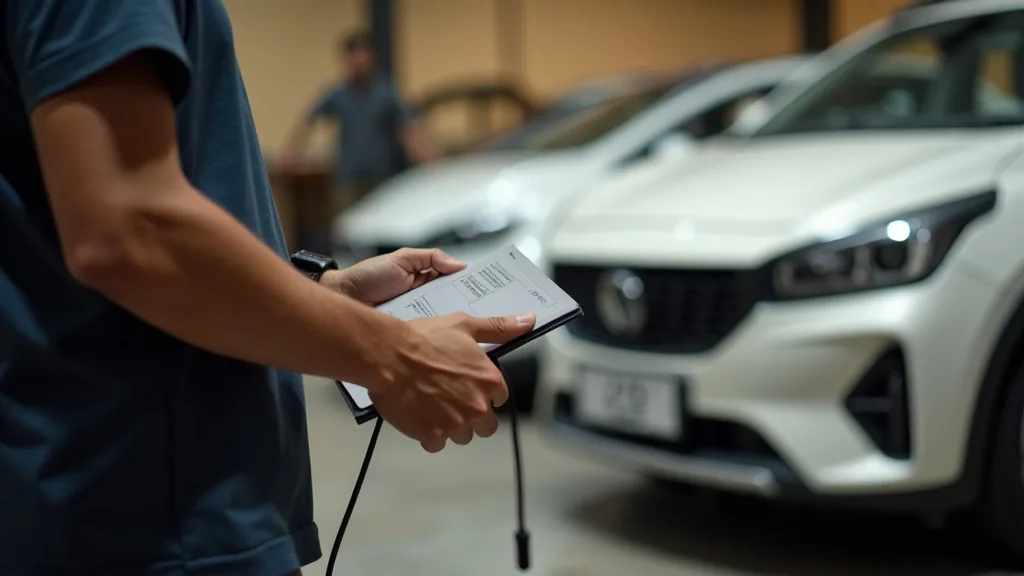
I Gusti Ngurah Rai (DPS) handled 24.1 million passengers in 2025 — 63% of them international — and the difference between a smooth electric car pickup and a slow one is knowing the sequence before you land. This guide walks the arrival step by step: the terminal flow, where your EV meets you, charging at the airport, and the timing traps worth planning around.
It pairs with the two booking pages on this site: self-drive EV at Bali Airport if you want the keys, and EV with driver if you want the chauffeur.
What happens between touchdown and the arrivals kerb at DPS?
The sequence never changes: immigration, baggage claim, customs, arrivals hall. The international and domestic terminals sit side by side at the single airport site in Tuban, so your meeting instructions work the same either way. What changes is duration — quiet mornings move fast, peak December days do not.
- Have your passport and any visa documentation ready before the queue, not in it.
- Message us on WhatsApp when you reach baggage claim — that is the staging trigger for your car.
- December is the crunch: the 18–28 December 2025 peak averaged 82,445 passengers per day, so build buffers into any high-season landing.
Where does your electric car meet you at Ngurah Rai?
At a meeting point in the arrivals area, confirmed by name and location in your WhatsApp thread before you fly. For self-drive, our team walks you to the car for a ten-minute document check and walk-around; for chauffeur bookings, your driver takes the luggage and you are moving immediately.
Airport handover is free — DPS sits inside our free-delivery corridor alongside Kuta and Seminyak. Prefer to land first and receive the car at your accommodation later? That option has its own page: electric car airport delivery, with a modest fee outside the free corridor.
Is there EV charging at Bali Airport?
Yes — Ngurah Rai airport is among Bali’s named public charging (SPKLU) sites, part of a network of 230 units across 164 locations at the end of 2025. You will not need it on arrival, because the car is handed over with a high state of charge. Note it instead as a departure-day option.
The wider network is thickest exactly where arrivals go: Kuta and Seminyak (including Beachwalk Shopping Center), ITDC Nusa Dua, Sanur, and multiple stations across Denpasar. Fast charging carries a Rp933.22 per kWh service fee, ultra-fast Rp1,133.22 per kWh, with PLN electricity capped at Rp2,467 per kWh.
What handover time should you schedule?
None — schedule against your flight number, not a clock time. Share the number at booking and the car or driver is staged to your actual landing, early or late. What you should time deliberately is everything after the handover, because Bali’s roads have a rhythm of their own.
- Road peaks run 08.00–10.00 and 16.00–19.00 daily; drive times can stretch 40–60% beyond quiet-hour figures.
- Mid-morning and early-afternoon landings thread the gap between both peaks.
- Peak-season taxi queues of 30–45 minutes do not affect a pre-arranged pickup, but they do crowd the kerb — one more reason the meeting point is fixed in advance.
Which direction should you drive first out of DPS?
Whichever your booking demands — but know the shape of each corridor before you commit to a first-evening plan. The airport sits at Bali’s narrow waist, so an electric airport pickup to Kuta, Jimbaran or Denpasar is measured in minutes, while Canggu and Ubud are measured in patience.
| First leg from DPS | Distance | Typical time | Note |
|---|---|---|---|
| Kuta | 3–4 km | 10–15 min | Closest drop; charging nearby including Beachwalk |
| Jimbaran | 7 km | 15–25 min | Southern charging corridor close by |
| Seminyak | 10 km | 20–40 min | Free-delivery corridor; dense charging belt |
| Nusa Dua (ITDC) | 12–13 km | 20–40 min | Via toll (Rp14,000); the island’s most EV-ready enclave |
| Denpasar centre | around 12–14 km | 12–31 min | Most charging stations of any area; toll optional |
| Canggu (Batu Bolong) | 18–20 km | 45–90 min | Slowest kilometres on the list; access roads congest |
| Ubud centre | 37–38 km | 60–105 min | Charge en route side: Gianyar stations confirmed |
The reverse legs — Kuta, Jimbaran or Denpasar back to Bali Airport for departure — run the same distances, so budget the same windows plus a check-in buffer. Heading up to Uluwatu or Pecatu (22–23 km, 45–75 minutes)? Plan charging around Nusa Dua or Jimbaran rather than counting on a top-up on the Bukit itself.
What if your flight is delayed or lands late at night?
Send the updated arrival time in your WhatsApp thread and the handover re-slots to match — that is the point of staging against flight numbers instead of clock times. Late-night landings are flagged at booking so the car and team are confirmed for your actual window, not an office schedule.
The same logic protects early arrivals. Land forty minutes ahead of schedule and the car is simply released to you sooner; there is no counter opening time to wait for. The one thing that cannot be compressed is immigration itself, which is why the checklist below is worth five minutes of your outbound layover.
What should be ready before you board?
Five items, all done from your phone before departure, all of which convert your DPS arrival from a queue into a sequence. Everything on this list has already gone wrong for someone this season; none of it needs to go wrong for you.
- WhatsApp booking confirmed, with the quote date-stamped (rates current as of August 2026).
- Flight number shared — the single detail that drives all timing.
- Licence plus International Driving Permit packed in hand luggage, if you are self-driving.
- Villa or hotel pin shared, so route and toll choice are settled before you land.
- Offline maps downloaded — signal is fine at DPS, but arrival is no time to test it.
Then book the car that fits the plan: WhatsApp +62 811-3941-4563 or bd@juaraholding.com. Self-drive from $29 per day, chauffeured from $113 per day — rate-by-rate detail on the transfer prices page.